Stainless steel bike spokes are worth it, and you probably already own them. Almost every quality spoke from brands such as Sapim, DT Swiss and Pillar is stainless. Plated or galvanized carbon-steel spokes rust, and they suit only budget wheels. The choices that matter more are spoke shape and nipple material.
This page covers material and selection. For the wider picture, see our guide to stainless steel bike parts.
Stainless or galvanized spokes?
Stainless wins for any wheel you care about. Sapim describes its aero spokes as 18/8 stainless steel, and the wheel-building guide at Bike Race Info says the vast majority of quality wheels are made from stainless steel wire.
Galvanized and plated spokes are carbon steel with a coating. They cost less, and the coating protects them while it lasts. Once it chips or wears at the elbow and the threads, rust follows. Sapim still lists plain steel lines such as Black Steel and Zinc in its basic range, which shows where those spokes sit, at the low end.
Stainless spokes can still show surface stains where water sits against the nipple or a spoke crosses another. That is cosmetic in most cases. Our guides on whether stainless steel rusts and on crevice corrosion explain why tight spots are where trouble starts.
Plain-gauge, butted or bladed?
A plain-gauge spoke has the same thickness along its length. It is cheap and easy to build with, and it is the heavy option. A butted spoke is thinner in the middle and thicker at the ends, which Sapim says gives reduced weight and increased strength. A bladed spoke is flattened in the middle to cut drag, and Bike Race Info says bladed spokes are typically stronger than butted spokes.
Examples to recognize:
- DT Swiss lists the Champion, Competition, Revolution and Aerolite among its spoke models, and its Competition page lists double-butted construction.
- Sapim sells butted lines such as Laser, Race and Strong, plus aero models such as CX-Ray.
For a commuter or touring wheel, a butted spoke is a sound middle choice. Bladed spokes mostly pay off on road wheels where aerodynamics count.
Brass or aluminum nipples?
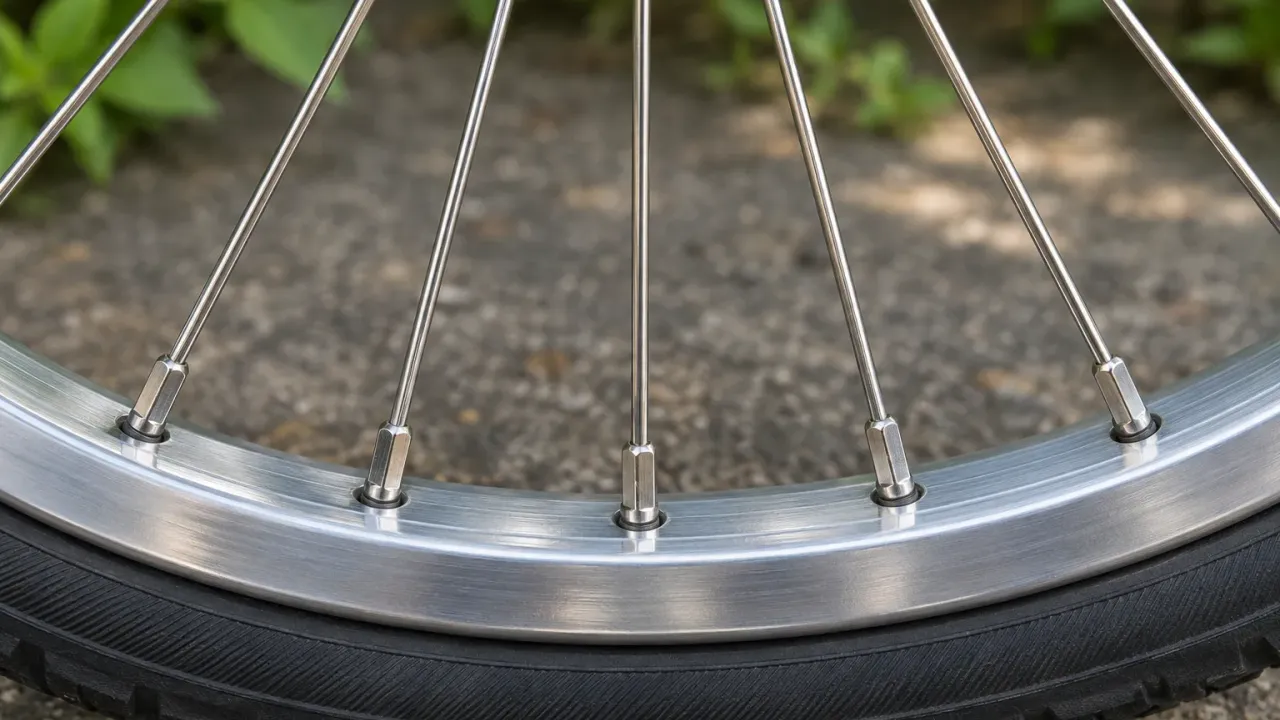
Brass is the safe default, and aluminum is the weight-saving option. Sapim says brass nipples are the most common material and are nickel-plated for corrosion resistance. It calls aluminum the preferred material for high-performance builds and uses a 7075 T6 grade.
Bike Race Info puts numbers on the trade. Brass nipples weigh about 1 gram each and alloy about 0.3 grams. It also warns that aluminum nipples are a big liability in high-corrosion areas, where they corrode faster than brass.
So the nipple, not the spoke, is usually where a wheel corrodes. Wheels that see road salt, rain or coastal air do better with brass. Aluminum fits dry-weather race builds where a few grams count.
The term “stainless steel spoke nipples” turns up in searches, but nipples are almost always brass or aluminum, not stainless. Check the listing before you assume a stainless nipple exists.
Are stainless spokes magnetic?
Some respond a little to a magnet, and that does not mean they are the wrong steel. Austenitic grades such as 18/8 are usually only weakly magnetic when annealed, but cold drawing and forming can raise the response. Our post on whether stainless steel is magnetic covers this in detail. A magnet cannot tell you the grade, so do not use it to judge a spoke.
How do you buy spokes cut to length?
Order by length, not by wheel size. Spokes are sold in millimeter lengths, and DT Swiss’s spoke range covers lengths from about 130 to 343 mm across its models. Your wheel builder or a spoke calculator works out the length from your rim and hub measurements, and many shops cut and thread spokes to order. A spoke that is too short will not reach the nipple threads, and one that is too long can poke through the rim bed.
Buy a few spares of the same model and length. If a wheel needs setup after a swap, the tension question belongs to the sister site, which covers it in its spoke tension guide.
Where do spokes fit with other parts?
Spokes are one of the places where stainless is close to standard. The other is the inner cable, covered in our guide to stainless steel bike cables. Frames are a different story, and the stainless steel vs chromoly vs titanium bike frames comparison explains why.