Choose aluminum-core stainless cookware when lower weight, broad availability, and value matter most. Choose copper-core cookware when a maker documents a copper layer through the body and your priority is fast heat adjustment. That is a construction tradeoff, not a universal winner: layer thickness, geometry, bonding, pan mass, burner, and measured pan performance matter at least as much as the metal’s conductivity.
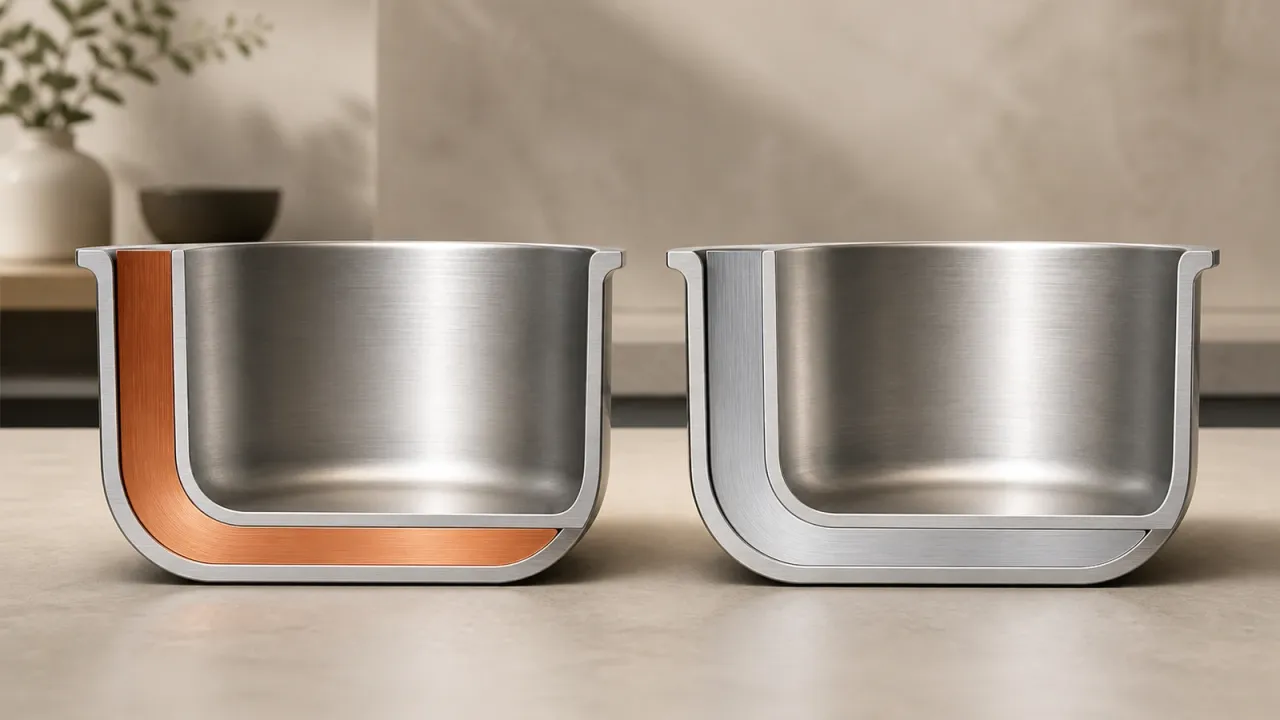
Illustration: an unbranded concept showing copper-colored and aluminum-colored layers inside stainless cookware. It is illustrative only and does not verify hidden construction in any real pan.
For the layer terms used here, start with what fully clad cookware means, then see 3-ply vs 5-ply cookware, disc-bottom vs fully clad cookware, and why stainless steel pans have aluminum cores. Those guides explain the broader construction choices. This page stays focused on the copper-versus-aluminum core decision.
The short answer
| Decision | Copper core | Aluminum core | What to verify |
|---|---|---|---|
| Heat spreading | Higher reference conductivity, if the layer is sized and bonded for the job | High conductivity with a low-density core option | Core material, thickness, shape, and bonding |
| Heat response | A strong material-property case for rapid adjustment, but not a pan-level guarantee | Often responsive in current stainless-clad designs | A measured test or a cautious maker statement |
| Weight | The material is denser, so equal-volume layers can add mass | The material is much less dense, but total pan weight still depends on the whole build | Weight for the same shape and size |
| Price | Often positioned as a premium in a maker’s lineup | Commonly used for value and lighter designs | Current matched prices and specifications |
| Food contact | The core should remain behind the documented stainless interior | The core should remain behind the documented stainless interior | Interior alloy, rim finish, and signs of separation |
The practical verdict is conditional. Copper has the higher conductivity in standard reference data, while aluminum offers high conductivity at much lower density. Neither fact tells you how a particular pan will heat. If the manufacturer does not identify the core, layer arrangement, and food-contact surface for the exact model, the material comparison is incomplete.
What the core changes, and what it does not
The core is the conductive layer hidden between the cooking surface and the outside of a layered pan. It is not a coating, and it is not the same thing as a product’s layer count. In sound cookware, the interior stainless layer is the surface that meets food while the core helps move heat through the vessel.
The National Institute of Standards and Technology reference table gives a useful materials starting point at about 295 K:
| Selected material | Thermal conductivity | Density | What the value can tell us |
|---|---|---|---|
| Copper | About 400 W/mK | About 8.96 g/mL | Heat can move readily through the material, but the material is dense |
| Aluminum | About 235 W/mK | About 2.70 g/mL | Heat can move readily through a much lighter material |
| 304 stainless steel | About 15 W/mK | About 8 g/mL | Stainless is far less conductive in this reference table, which explains why cores are used |
Those are selected-material reference values, not performance measurements for cookware. A pan adds stainless layers, interfaces, a particular core thickness, curved walls, a base shape, a burner, food, and a control setting. Thermal conductivity is one input to that system. It is not a score that can rank every copper-core pan above every aluminum-core pan.
Copper core: where the material edge can matter
Copper’s conductivity gives it a clear material-property advantage over aluminum in the NIST reference data. If a copper layer is thick enough, bonded well, and placed where it affects the relevant heat path, it can reduce resistance to heat moving across the pan. That is the reason copper-core cookware is often aimed at cooks who want close control over delicate sauces or frequent heat changes.
The important phrase is “if the construction supports it.” A very thin copper layer behind thick stainless, a small heating zone under a wide pan, or a heavy vessel can change the result. Interfaces between metals, the pan’s wall and base geometry, and the amount of metal that must warm all affect the time and uniformity a cook experiences. No hands-on or side-by-side measurements were made for this comparison.
An exact current example is All-Clad’s Copper Core Essential Pan. The manufacturer describes a fully bonded five-layer construction with a copper center, aluminum layers, and stainless steel, plus a copper ring that reveals the bonded core at the rim. That is useful model-level construction evidence. It does not prove that every cookware line marketed as copper core uses the same layer order, thickness, or body coverage.
The copper ring is also a clue, not a substitute for a specification. A product photograph can show an exposed design detail, but it cannot establish the complete hidden construction of another size or collection. Use the exact model page and current manual when the material is important to your decision.
For this dimension, copper wins the material-property comparison. It does not automatically win a pan-performance comparison because the pan’s geometry and mass remain unknown.
Aluminum core: why it remains a strong general-purpose choice
Aluminum combines high conductivity with much lower density than copper in the NIST table. That makes it a practical way to distribute heat through stainless cookware without making the conductive layer as heavy as an equal-volume copper layer would be. The actual result still depends on how much aluminum is used, what alloy surrounds it, and how the layers are bonded.
All-Clad’s current D3 Stainless Everyday description names an 18/10 stainless interior, an aluminum core, and a polished stainless exterior in a fully bonded three-layer construction. The same page describes that line as lighter and more affordable than Copper Core. That is a useful comparison within one manufacturer’s lineup, not a universal price or weight rule for every brand.
Made In’s construction explanation gives another current manufacturer example. It identifies a 304 stainless cooking surface, pure aluminum layers, and an aluminum alloy layer in its Stainless Clad cookware. The example shows why “aluminum core” is only a starting label. Alloy choice, layer count, thickness, and the manufacturing process can all vary.
Aluminum-core cookware is not automatically a compromise. A well-sized aluminum layer can provide the heat distribution and adjustment most home cooking needs, while the stainless interior provides the working surface. If a maker gives no thickness, cross-section, or exact layer description, do not fill in those gaps from the word “tri-ply,” “clad,” or a retailer photograph.
For this dimension, aluminum is often the more practical starting point when handling and value matter. That conclusion still belongs to the exact pan, not to aluminum as a universal winner.
Heat response: copper has the property edge, not every pan edge
Heat response means how the cooking surface changes when the heat source changes. It is different from heat spreading and different from heat retention. A conductive core can help spread energy across the pan, but the surface also has to warm and cool through the rest of the layer stack.
The safest comparison is therefore conditional:
- Copper is attractive when the exact construction gives its higher conductivity a meaningful path through the body and the cook values quick adjustment.
- Aluminum can be highly responsive when the layer is adequately sized and the pan is not carrying unnecessary mass.
- A manufacturer claim about “rapid” or “even” heating describes the maker’s intended design. It is not a controlled result across all burners, pan sizes, recipes, or heat settings.
All-Clad describes Copper Core as intended for rapid, responsive heat control, while Made In describes its aluminum-core Stainless Clad construction as responsive. Those statements support the design goals of the two lines. They do not provide a neutral test between copper and aluminum. For a measured performance claim, look for a test that uses the same pan shape, dimensions, burner, starting temperature, and measurement method.
For cooks who make frequent reductions or adjust a delicate sauce by small increments, copper may be worth the premium when the construction evidence is clear. For ordinary sautéing, simmering, and searing, an aluminum-core pan with suitable mass and geometry may meet the need. There is no evidence here for a universal response winner.
Weight and handling: compare the exact piece
Copper’s density is more than three times aluminum’s in the NIST reference table. If two cores had the same volume, the copper one would contribute more mass. Cookware is not a block of equal-volume core material, though. Stainless skins, extra layers, wall height, diameter, handle design, lid weight, and the maker’s target thickness can outweigh that simple comparison.
The current All-Clad D3 description provides a useful real-world constraint by calling D3 lighter than Copper Core. That does not allow a comparison between every D3 and every Copper Core piece, but it does show why a buyer should compare the listed weight of the same type of vessel instead of assuming from the core name.
Choose the lighter exact piece if you move a full pan often, have limited wrist strength, or want easier one-handed pouring. Choose the heavier piece only when its construction, stability, or cooking job justifies that handling cost. Weight is an exact-product decision, not a material slogan.
Price: treat copper as a possible premium
Copper-core cookware often occupies a premium tier, but the reason can include more than the raw metal. The maker may use additional stainless or aluminum layers, a different bonding process, a polished finish, a thicker body, a particular handle, or a longer warranty. Aluminum-core cookware spans inexpensive, midrange, and premium construction too.
The All-Clad D3 page explicitly positions D3 Stainless Everyday as lighter and more affordable than Copper Core. That supports a value tradeoff within that collection. It does not establish a market-wide price gap, and prices can change before this scheduled draft is published. Compare like with like: the same vessel type, size, lid, handle configuration, warranty, and current construction specification.
For this dimension, aluminum-core cookware is the likely value path when two otherwise comparable lines are priced differently. Copper is the premium path only when the documented construction and your heat-control priorities justify paying more. Do not treat the price itself as proof of better pan performance.
Food contact: the inner layer matters more than the core label
An intact layered pan should keep its conductive core behind a stainless cooking surface. Made In identifies 304 stainless as its cooking surface and says the aluminum core is insulated by stainless steel. That is the kind of direct food-contact statement to look for. A generic listing that says only “stainless cookware with copper core” leaves the inner alloy and layer boundaries less clear.
Copper and aluminum are both core options, not automatic food-contact surfaces. Check the exact manufacturer’s description for the interior layer, rim treatment, and any coating or insert. If a pan has a split seam, lifted layer, sharp exposed metal, bubbling, or a core visible where food sits, stop using it and ask the maker about replacement or support. Do not sand or grind the surface to investigate.
This dimension is a tie when both exact models document a sound stainless interior. The winner is the model with clearer food-contact evidence, not the core material with the more impressive name.
Construction evidence: exact wording beats shorthand
Read the current manufacturer page for the exact model or collection, then check whether it states:
- The core material, not just “multi-layer” or “clad.”
- Whether the named core runs through the body or is limited to a base.
- The interior material that contacts food.
- Any published layer thickness, body thickness, weight, and care limits.
- How the maker supports separation, warping, or other construction damage.
The distinction between a copper core and a copper base is especially important. Demeyere’s technology page describes a copper layer sealed into its InductoSeal base while also describing aluminum in its multi-layer pan material. That is a current manufacturer example of why “copper in the construction” does not necessarily mean a copper core through the walls.
Do not use a copper-colored ring, a cross-section drawn for a different model, or a marketplace title to fill in an omitted specification. If the source does not say which metal is in the core, record the construction as unknown. For the broader question of where a conductive layer sits, use the linked construction guides rather than turning this page into a layer-count or base-style ranking.
Which core should you choose?
Choose an aluminum core when:
- You want a lighter design and the exact pan’s weight supports that goal.
- Value matters and the maker documents a suitable stainless cooking surface.
- You want a widely used conductive core without paying for a copper-focused premium.
- The pan’s shape, thickness, and burner match your everyday cooking.
Choose a copper core when:
- You care most about heat adjustment and the exact maker documents copper through the relevant body.
- The premium, density, and care requirements fit your handling and budget.
- You are buying for delicate temperature work and understand that the material advantage is not a measured guarantee.
- The full layer arrangement and stainless food-contact surface are clear.
Choose neither based on the name alone when the listing omits the core’s location, layer thickness, interior material, or model-specific support terms. In that case, a well-documented aluminum design is easier to evaluate than an impressive but unverified copper claim.
How we compared
This is a research-based construction comparison, not a hands-on or side-by-side test. The approved research and exact-query review were captured August 20, 2026. I checked the NIST reference table and current manufacturer construction pages from All-Clad, Made In, and Demeyere on August 21, 2026.
The comparison covers material-property context, manufacturer construction wording, heat-response limits, density and handling tradeoffs, value signals, and the food-contact boundary. It does not rank products, measure pan temperatures, test burner recovery, infer performance from conductivity alone, or treat a product photograph as proof of hidden layers. No universal winner is claimed. Recheck the current model page, price, weight, care instructions, and warranty before buying.