No. If a stainless steel cookware base is actually separating, stop using the piece. Let it cool without moving it, set it aside, photograph the defect, and contact the manufacturer or retailer for warranty or replacement instructions. Do not reheat it to see what happens, hammer it flat, glue it, weld it, or keep cooking with it.
A separating disc is a structural problem, not a cleaning mark. The edge may lift only slightly at first, and a photograph cannot reveal how much of the hidden bond remains. This guide uses visible signs to set a conservative stop-use boundary. It does not diagnose the bond, assign a cause, or promise a repair.
What does a separating base mean?
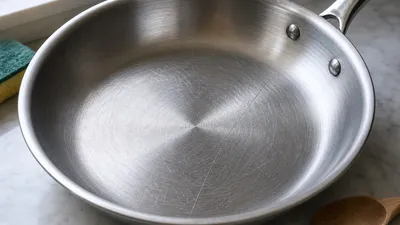
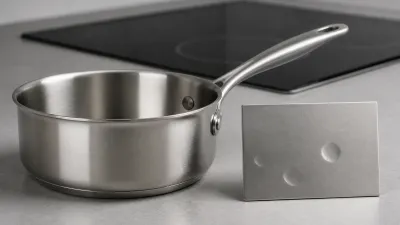
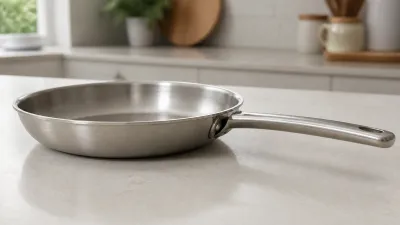
A separating base means the plate or layered disc attached under a base-only pan no longer appears fully joined to the stainless body. Disc-bottom, impact-bonded, encapsulated-base, and tri-ply-base cookware put conductive metal under the cooking floor, while fully clad cookware carries its bonded layers into the sidewalls. Our guide to disc-bottom versus fully clad cookware explains that construction difference without treating either design as a guarantee against failure.
The visible edge is not necessarily the whole defect. A base can look intact from one angle while a section has lifted, loosened, or developed a gap. Conversely, a dark ring, a machining line, or a smooth heat stain can look alarming without being a separation. The maker’s drawings, service team, and inspection process are better suited to identifying the exact construction.
Which signs mean you should stop using the cookware?
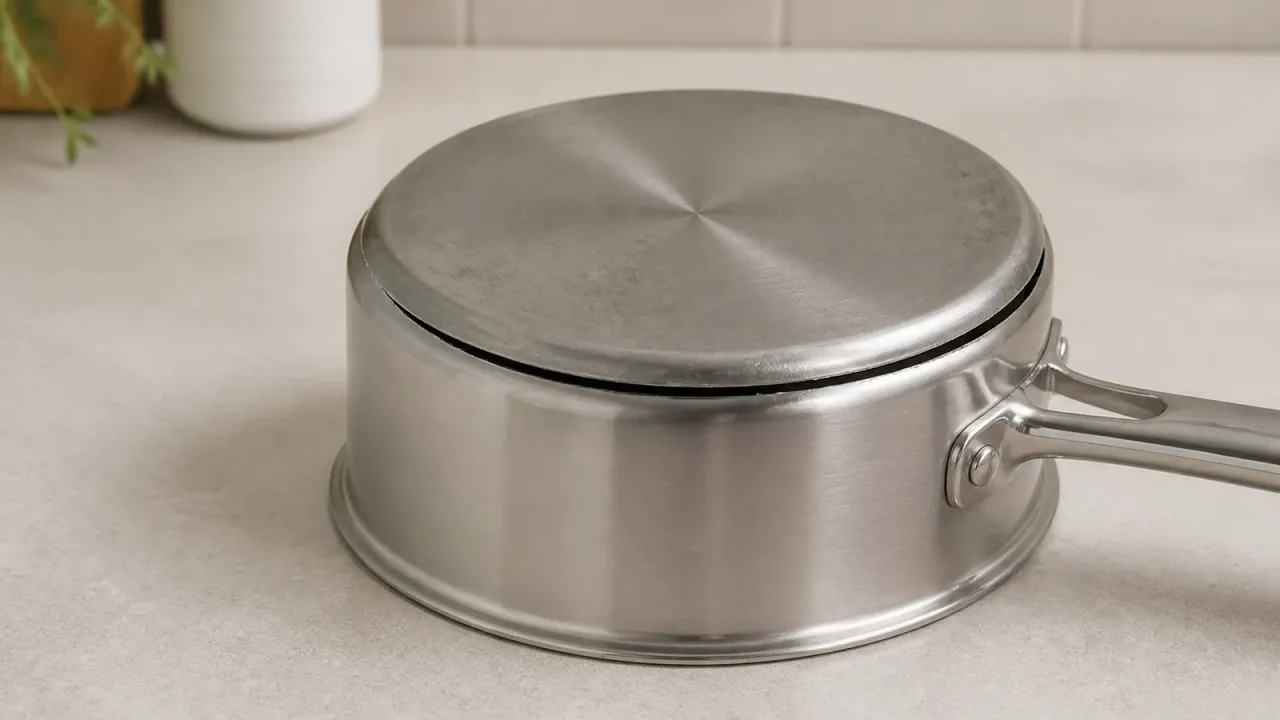
An actual gap, lifted disc edge, loose or rattling base, sharp lip, exposed inner material, or movement between the disc and the pan is enough reason to stop using it until the maker assesses it.
| What you see on a cool, dry piece | Conservative decision |
|---|---|
| Smooth brown, blue, gold, or rainbow discoloration with no gap or edge movement | Treat it as an appearance issue first. Follow the maker’s cleaning instructions, and do not abrade a suspected structural mark. |
| A small flatness change with no loose layer, sharp edge, or rocking | Compare the cool piece with the maker’s specifications. Minor flatness is not proof of delamination, but stop if the piece is unstable or the maker says it is out of tolerance. |
| A dark line that is a real open gap, a lifted perimeter, or a disc that shifts | Stop using it. Do not press the disc back into place. |
| Rattle, clicking, scraping, or a loose part when the cool piece is handled normally | Stop using it and keep it isolated. Do not shake it to reproduce the sound. |
| Sharp metal, flaking, exposed core material, a growing edge, or a leak | Stop using it, keep hands and food away from the area, and ask the maker or retailer for the next step. |
These signs are deliberately conservative. The stainless steel pan-warp guide covers a changed shape, rocking, and thermal-shock damage. Warping and base separation can occur together, but a warped pan is not automatically a delaminated pan, and a flat pan can still have a loose base.
How can you inspect a suspected separation without reheating it?
You can inspect the cool cookware visually and document it without heat, impact, probing, or other destructive testing.
- Turn off the heat, if the piece is on a cooking surface, and leave it where it is until it is cool enough to handle safely. Do not carry a hot pan with a loose-looking base. If it is already cool, do not warm it for this inspection.
- Move the cool piece to a dry, stable counter. Wash away ordinary residue with the maker’s approved mild method only if needed to see the base, then dry it. Do not use a scraper, abrasive pad, solvent, or chemical treatment to expose an edge.
- Place the piece upside down under bright, even light. Look around the complete perimeter of the base, not only the side that first caught your eye. Use a second angle of light or a phone photograph to record the line, but do not insert a card, knife, fingernail, wire, or other object into it.
- Look for a continuous open gap, a lifted section, a change in the base’s outline, exposed dissimilar metal, or debris trapped at the edge. Do not pull, twist, tap, flex, or press the disc to test whether it moves. A home inspection should observe the condition, not enlarge it.
- Check the pan body and handle for separate damage, but do not use the pan to test whether it still heats evenly. A suspected base problem is enough to stop the inspection. Do not put water, oil, or food in it.
- Photograph the whole piece, the underside, the suspected edge, the model or size marking, and any receipt or packaging information. Keep the original photos and note when and where you noticed the change.
- If the line might be discoloration, a factory join, or ordinary flatness rather than an open gap, ask the maker for a model-specific assessment. Do not resolve uncertainty by reheating the cookware.
This workflow cannot certify a bond. Testing the interface in the technical literature uses controlled specimens, microscopy, and mechanical or adhesion measurements, not a consumer heat test. A clean-looking edge therefore does not prove that a hidden bond is sound.
Why can a bonded base separate?
The cause can be a manufacturing defect, prolonged high heat, thermal cycling, impact, or another product-specific condition, but the cause cannot be assigned from appearance alone.
Meyer describes its impact-bonded base as a pressure-and-friction joint and says that continuous very high-temperature heating can weaken the bond over time; it also says a manufacturing defect may qualify for replacement. That is the maker’s explanation for its Select range, not a universal failure rule for every brand or joining method. Made In similarly separates manufacturing defects from damage associated with prolonged high heat or thermal shock in its stainless-clad warranty.
The materials can also differ. NIST lists a linear thermal-expansion coefficient of about 22.91 × 10⁻⁶/K for aluminum and about 15 × 10⁻⁶/K for 304 stainless steel at 295 K. A 2025 study of stainless steel and aluminum cladding says bonding process, interface strength, pressure, and forming conditions affect delamination risk. Those sources explain why a bonded dissimilar-metal interface needs engineering and controlled testing. They do not show that a particular household pan failed for one of those reasons.
Do not infer that every gap will eject, leak, contaminate food, damage a cooktop, or cause a fire. Those outcomes depend on the exact product and defect. The visible separation is enough to stop use without guessing at a more dramatic result.
Should you reheat, hammer, weld, or glue the base?
No. None of those actions is a consumer inspection or a reliable repair for a separating cookware base.
Reheating can change the gap and add another thermal cycle to an already uncertain interface. It cannot tell you whether the bond will remain stable during ordinary cooking, and it can make the condition harder for a service team to evaluate. All-Clad tells consumers not to use a base that is uneven upon purchase and to contact customer service, while its care guidance warns that high heat and sudden cooling can distort cookware.
Hammering or pressing the disc can deform the pan, enlarge a lifted edge, and alter the contact surface. Welding is also not a household fix: it adds concentrated heat, requires compatible materials and a controlled process, and can damage the pan or its finish. No DIY welding procedure can be inferred from a stainless exterior.
Glue is not a safe shortcut. A random adhesive is not automatically authorized for food-contact use or for the temperatures a cookware base reaches. FDA guidance explains that food-contact substances, including adhesives, are evaluated for an intended use, migration, and conditions of use. Meyer specifically says no adhesive is used in the impact-bonded base described on its FAQ. Cuisinart’s cookware warranty excludes unauthorized alteration or repair. Keep the failed piece intact and ask the maker what remedy it authorizes.
What should you do after finding a real gap?
After confirming an observable separation, use this stop-use sequence:
- Stop cooking with the piece and let it cool fully if it is warm.
- Isolate it where nobody will grab the loose edge and where it cannot touch food, other cookware, or a cooktop. Do not stack another pan on it.
- Photograph the defect before cleaning, prying, bending, or attempting any repair.
- Record the brand, line, model or size, markings on the underside, approximate purchase date, seller, receipt, and the heat source and care history you can state accurately. Do not invent a temperature or a cause.
- Contact the manufacturer through its current service or warranty channel and contact the retailer if its return or consumer-law process may apply. Ask whether it wants the piece retained, returned, or photographed. Follow its shipping and handling directions.
- Check the maker’s recall page and your local consumer-product recall database for the exact model. A 2026 CPSC recall involving a different stainless sauté-pan component told owners to stop using the recalled product and contact the maker for a refund after a metal cap detached and ejected. That was a product-specific finding, not a prediction that every separating cookware base will eject.
All-Clad directs owners with manufacturer defects to consumer service. Cuisinart says original proof of purchase remains important for warranty benefits and warns that unauthorized repair may affect coverage. Warranty terms, retailer rights, and remedies vary by brand and location, so preserve the evidence and ask before sending or discarding the piece.
How should you dispose of a failed cookware base?
Follow the manufacturer’s return or recall instructions first, then follow your local waste or recycling authority for the remaining cookware. Mixed stainless steel, aluminum, coatings, handles, and rivets may not belong in ordinary curbside recycling, and local programs differ. Do not put a sharp or partly detached piece loose in a recycling bin. If the maker does not offer a return, ask the local program how to contain and present the cooled metal item.
Is cookware with a separating base safe for food?
You cannot establish food safety from a photograph or from the fact that the cooking surface still looks like stainless steel. A separation does not by itself prove toxic-metal release or contamination, but it does create uncertainty about the finished product’s condition and intended food-contact construction.
The stainless steel cookware safety guide explains why food-contact suitability depends on the finished article and its use, not on a grade label alone. For a pan with a lifted, loose, sharp, or exposed layer, the practical safety decision is to stop using it and get a product-specific answer or replacement. Do not use the pan while waiting for a warranty response.
Frequently asked questions
Can I use a pan with a small gap if it still sits flat?
No. If the gap is a real separation rather than a printed line or finish change, stop using the pan even if it still sits flat. Flatness does not prove that the hidden bond is intact.
Is a loose base the same as a warped pan?
No. Warping changes shape, while separation is loss of contact between joined parts. The two conditions can overlap, so use the guide to what fully clad cookware is for intact construction and the pan-warp guide for shape changes.
Can a cookware repair shop reattach the disc?
Do not arrange a repair before the manufacturer or retailer reviews the defect. A shop may not know the original joining method, food-contact boundaries, heat limits, or warranty requirements. Ask the maker for an authorized remedy, which may be replacement rather than repair.
What does this guidance not cover?
This answer is limited to a cooled, household stainless pan with an observable or suspected separating base. It does not diagnose hidden delamination, evaluate pressure-cooker or electric-appliance hazards, approve repairs to nonstick or other coated surfaces, or replace instructions for a recalled model. Follow the product’s current safety notice or manual for those cases. If the cookware is hot, smoking, sparking, leaking, or involved in an active fire, move away and follow emergency guidance instead of inspecting it.
Sources
- Meyer India, FAQs (retrieved 2026-08-21)
- All-Clad, Warranty & Repairs and Product Support FAQ (retrieved 2026-08-21)
- Cuisinart, Warranty (retrieved 2026-08-21)
- Made In, Warranty Policy (retrieved 2026-08-21)
- U.S. Food and Drug Administration, Food Packaging and Other Substances that Come in Contact with Food (retrieved 2026-08-21)
- U.S. Consumer Product Safety Commission, Granitestone Diamond Pro Blue Stainless Sauté Pan recall (retrieved 2026-08-21)
- Development and Characterization of Cladding AISI 304L Stainless Steel on Aluminum (Journal of Manufacturing and Materials Processing, 2025; retrieved 2026-08-21)
- NIST, Reference Tables (retrieved 2026-08-21)