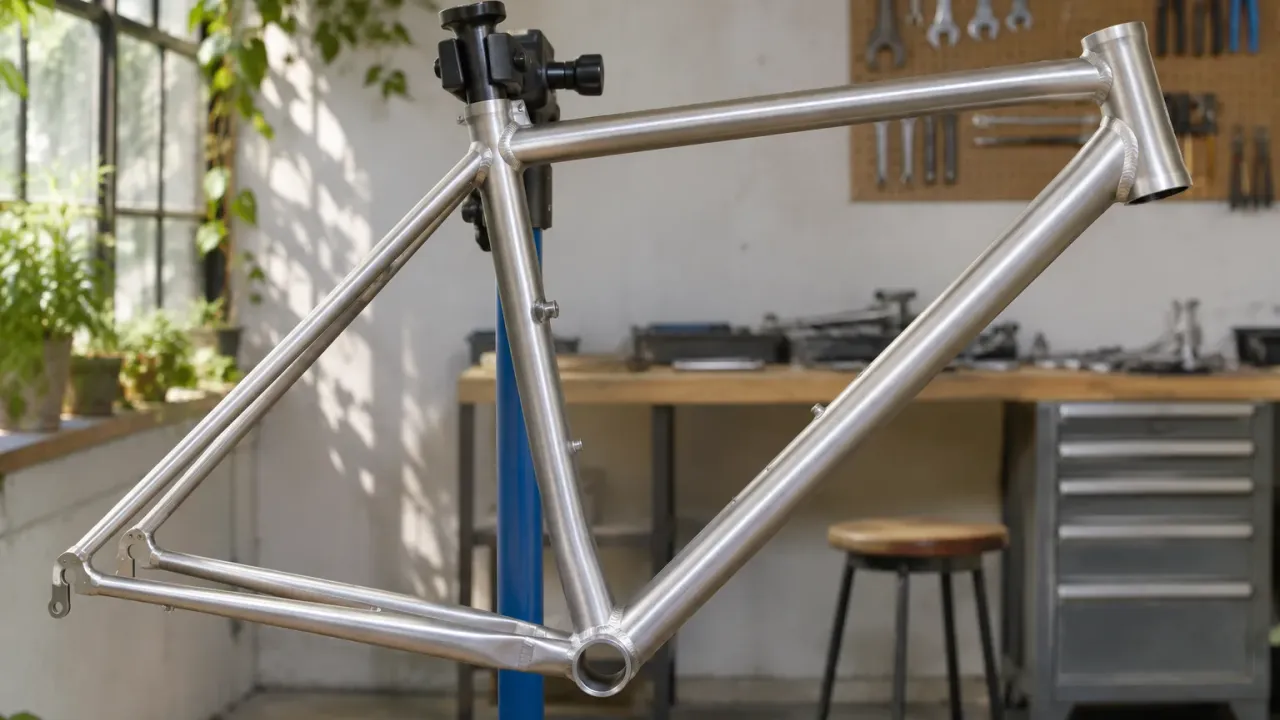
A stainless steel bike frame is worth a premium if you want a steel frame that never needs paint and resists rust from the inside out. Choose 4130 chromoly if you want the best value and a frame any shop can repair. Choose titanium if you want a bare, rust-free frame and your priority is low weight over a springy steel feel.
Stainless frames are also the narrowest choice of the three. They are built by a small group of custom builders, often to order, so most riders will compare them against chromoly and titanium rather than buy one off a shelf. The frame is the largest part covered in our guide to stainless steel bike parts, and the one where stainless pays off least often.
Which frame for which rider
| Rider | Best fit | Why |
|---|---|---|
| Budget or first steel frame | Chromoly | Widest range, easiest repairs, lowest cost of entry |
| Wet, salty, or coastal commuter | Stainless or titanium | No paint to chip and no steel interior to rust |
| Custom road or gravel bike, steel feel | Stainless | Bare finish with the repair path of steel |
| Lightest frame and longest service life | Titanium | An identical frame could be roughly half the weight of steel |
| Remote touring | Chromoly | Steel can be fixed with a torch and brazing know-how |
Stainless vs chromoly vs titanium at a glance
| Decision | Stainless steel | 4130 chromoly | Titanium |
|---|---|---|---|
| Rust behavior | Resists rust inside and out | Needs paint and interior protection | Resists corrosion |
| Finish | Bare or polished, no paint needed | Painted or powder coated | Bare, brushed, or matte |
| Ride feel | Steel stiffness, thin walls possible | Steel stiffness | Less stiff material, larger tubes |
| Weight | Depends on wall thickness | Depends on wall thickness | Lighter for a comparable frame |
| Repair | Welding or brazing by a builder who knows the alloy | Easiest to weld or braze | Specialist welding with inert gas |
| Cost tier | Typically a premium over chromoly | Lowest of the three | Costs more than chromoly |
| Availability | Custom and boutique | Widest | Moderate, mostly specialist makers |
What stainless means in a frame
The stainless in a frame is not the 304 or 316 found in a kitchen sink or water bottle (see the grades chart). Frame tubing uses high-strength alloys that can be drawn thin and still hold up under load.
Columbus describes its XCr tubing as a biphasic stainless steel, drawn seamless from a solid billet, with walls as thin as 0.4 mm. Columbus lists 1450 MPa ultimate tensile strength and says the polished surface needs no paint or clear coat, because the surface is the finish. Condor, a London builder, sells a stainless frameset built from XCr.
Reynolds 953 was the other well-known name. Reynolds calls it a martensitic-ageing stainless alloy with tensile strength above 2000 MPa, but its own materials page now lists it under past materials and says the range is no longer offered for new orders because of restricted material supply. If you see a used 953 frame, you are buying a discontinued tube set.
KVA’s MS2 is an air-hardenable martensitic stainless made in the United States for custom builders. KVA’s launch material claimed it was twice as strong as titanium, which is a company claim from 2010, not an independent test.
Because several of these alloys are martensitic, a magnet may stick to them. The magnetism of stainless steel depends on the grade, so a magnet test tells you little about quality.
Corrosion
Chromoly is the weak point here. The paint protects the outside, but moisture can sit inside the tubes where nobody sees it. Velo Orange notes that most steel frames never get interior treatment and still last for decades, and that you occasionally see a rusted-out frame, particularly where road salt is used. Its advice for a nice frame is to spray Frame Saver into the tubes. That is cheap, but it is a task you must do once.
Stainless removes the interior problem and the paint problem. Stainless can still stain or show surface rust, as covered in does stainless steel rust, but a frame alloy designed for thin tube walls resists it far better than carbon steel. Columbus claims strong resistance to stress corrosion cracking for XCr, and KVA claims excellent corrosion resistance for MS2. Both are maker claims.
Titanium is widely described as corrosion resistant, and titanium makers sell frames with no paint at all. Lynskey, for example, offers raw mill and brushed finishes and says scuffs on them can be reworked with a scouring pad.
Verdict: stainless and titanium tie, and both beat unprotected chromoly.
Ride feel and weight
Do not expect the material name to settle ride feel. Sheldon Brown points out that all kinds of steel have basically the same stiffness and density, so a stainless frame is not lighter than a chromoly frame by material alone. What changes is how thin the tubes can be made. The strong stainless alloys above allow thinner walls, which is where the weight savings come from.
Titanium is different. Sheldon Brown notes that titanium is less stiff than steel, so builders use larger tubes, and an identical frame could be roughly half the weight of the steel version.
Maker claims fill the gaps. Condor claims a stiffness-to-weight ratio above titanium for its stainless frame. Treat those as marketing numbers, because frame size, tube shapes, and builder choices all move the result.
Verdict: titanium for weight, and a tie between chromoly and stainless on stiffness unless the stainless tubes are thinner.
Repair, welding, and brazing
Chromoly wins on repair. Steel can be fixed with a torch and brazing knowledge, which is why it suits remote touring. Almost any frame shop can repaint, braze on a new bracket, or fix a cracked joint.
Stainless frames can be TIG welded or silver brazed. Columbus names APX4S filler for TIG welding and a silver alloy, T99, for brazing XCr. Repair needs a builder who knows the specific alloy and filler, so you may be sending the frame back to the maker.
Titanium needs inert gas shielding on both the inside and outside of the tube. That is a specialist job, because poor shielding contaminates the weld. Expect to rely on a titanium builder for repairs.
Verdict: chromoly, then stainless, then titanium.
Finish
A painted chromoly frame is cheap to refresh and easy to color. When it chips, it needs touch up before rust spreads.
A stainless frame can be left bare or polished, with no paint to chip. Dings and scratches are part of the look. A titanium frame also ships bare, with finishes ranging from rough mill to brushed or matte. Some finishes can be reworked at home and others need the factory.
Verdict: stainless and titanium for riders who want no paint, chromoly for riders who want color.
Cost
Stainless and titanium frames are mostly made by boutique and custom builders. Stainless frames typically carry a premium over chromoly, and the custom tubing, thin walls, and builder skill add to it. Titanium also costs more than chromoly. We do not list prices because builder quotes, wait times, and tube sets change.
Chromoly frames from makers such as Ritchey and Surly sit at the value end, in stock sizes. A custom stainless frameset can have a lead time of many months, so ask the builder before you plan a build.
Verdict: chromoly.
Which should you choose
Pick chromoly if you want a durable, repairable frame at the lowest cost and you are willing to treat the inside of the tubes once. Pick stainless if you want a steel frame that stays bare, you ride in wet or salty conditions, and you can wait for a custom builder. Pick titanium if weight and a bare finish matter most and you accept a specialist for any repair.
For other stainless parts on the same bike, see the spoke guide and the cable guide. For another material tradeoff, see titanium vs stainless steel cookware.
How we compared
This is a research-based comparison, not a hands-on or side-by-side test. We read the tube makers’ own pages, builder and maker material, and a classic frame-materials explainer, then compared the claims on rust, ride, weight, repair, finish, and cost tier. Strength and weight figures from makers are marketing claims unless noted, and no one rode or weighed these frames for this page. Sources were reviewed November 12, 2026.
Sources
- Columbus, XCr stainless seamless steel (retrieved 2026-11-12)
- Reynolds Technology, past materials (953) (retrieved 2026-11-12)
- BikeBiz, KVA Stainless seam-welded tubing (2010) (retrieved 2026-11-12)
- Condor Cycles, Acciaio stainless frameset (listing confirmed by search 2026-11-12)
- Sheldon Brown, frame materials (retrieved 2026-11-12)
- Velo Orange, how to use Frame Saver (retrieved 2026-11-12)
- Lynskey Performance, FAQ on finishes (retrieved via search 2026-11-12)