Do not choose from the word titanium alone. For most home kitchens, documented clad stainless steel offers the clearest balance of construction, value, and repair-free durability; titanium-labeled cookware makes sense when its exact body, coating, or surface treatment solves a specific need.
The label can describe a titanium body, a titanium-containing alloy, and a titanium-treated surface. It can also appear in marketing for a nonstick coating. Those products are not interchangeable.
Titanium vs stainless steel at a glance
| Decision | Titanium-labeled cookware | Clad stainless cookware | Better choice |
|---|---|---|---|
| Construction clarity | Varies widely | Commonly disclosed by layers | Stainless steel |
| Weight | Solid titanium can be light | Usually moderate to heavy | Titanium body |
| Heat spreading | Often needs another conductive metal | Commonly uses aluminum or copper | Depends on core |
| Surface behavior | Alloy, treatment, or coating dependent | Uncoated steel needs technique | Depends on surface |
| Availability | Specialist and premium | Broad range | Stainless steel |
| Value | Benefit must justify a premium | Many proven price levels | Stainless steel |
First identify what titanium means
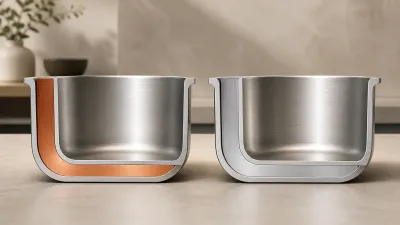
Hestan NanoBond is clad stainless cookware with an aluminum core and molecular titanium layers bonded to its stainless cooking surface. Heritage Steel’s Titanium Series instead uses 316Ti stainless, an alloy stabilized with titanium, over an aluminum core. Neither is a pan made from a thick solid titanium body.
Outdoor cookware may use a largely titanium vessel to reduce carrying weight. Some nonstick cookware uses titanium particles or branding in a coating whose release and lifespan depend on the full formulation. Ask what touches food, what spreads heat, and whether the titanium is a body, alloy addition, bonded treatment, or coating.
Winner: Stainless steel for an easier apples-to-apples purchase.
Cooking performance
Material names do not determine even heating. Hestan attributes NanoBond’s heat conduction to its aluminum core, not to the thin titanium treatment. Heritage Steel also places aluminum inside its five-ply construction. This is why fully clad cookware is the useful shared definition.
An uncoated stainless surface browns and builds fond but needs heat and fat control. A titanium-treated stainless surface may resist scratching or staining differently, while a titanium-reinforced nonstick surface remains a coating system. Compare it through the stainless versus nonstick decision if easy release is the promise.
Winner: Depends on the conductive core and food-contact surface, not the titanium word.
Weight and durability
Solid titanium’s strength-to-weight ratio suits camping pots, where carrying weight matters more than broad stovetop refinement. Premium titanium-treated clad pans are not necessarily lighter than ordinary clad stainless because they still contain steel and aluminum.
Titanium treatments and alloy additions can improve surface properties, but manufacturer claims are product-specific. They do not prove that all titanium cookware is four times harder, more nonstick, or nickel-free. Heritage Steel’s 316Ti surface contains a different alloy system from Hestan’s stated nickel-free NanoBond cooking surface.
Winner: Solid titanium for trail weight; product-specific for kitchen durability.
Food contact and care
Use the exact maker’s instructions and disclosure. Food-grade stainless steel is about a finished article’s intended use, not one fashionable element. A titanium label does not disclose every metal, coating, handle, adhesive, or core in a pan.
Uncoated clad stainless commonly tolerates metal utensils and firm cleaning, subject to its finish. Titanium-treated stainless may permit similar or stronger treatment. Titanium-branded nonstick usually requires coating-safe heat and utensils. Never transfer care rules between these categories.
Winner: Tie after the construction is known.
Which should you buy?
Choose conventional clad stainless if you want a widely available workhorse for searing, sauces, and acidic food. The pros and cons of stainless cookware explain its sticking and cleaning tradeoffs.
Choose solid titanium for portable cooking when low weight is the main requirement. Consider titanium-treated or titanium-alloy stainless only when the disclosed surface benefit is worth its price. Do not pay a premium for an undefined “titanium-infused” claim.
Continue through the cluster with the aluminum comparison, copper comparison, enameled cast iron comparison, and hard-anodized comparison. The ceramic comparison covers another coating-based claim.
Final verdict
Stainless steel wins as the default kitchen purchase because its construction is easier to evaluate and its options span more budgets. Titanium can add real value, but only after you identify its role in the finished pan.
This is a research-based construction comparison, not a hands-on durability test. Manufacturer specifications were reviewed July 11, 2026.
Sources
- Hestan, NanoBond titanium cookware construction (retrieved 2026-07-11)
- Heritage Steel, Titanium Series five-ply construction (retrieved 2026-07-11)